

Quick Answer
Run an AI infrastructure audit before scaling by tracing each production workload through compute, storage, networking, orchestration, observability, and cost controls. Do not approve more capacity until you can identify the limiting resource, reproduce peak behavior, and assign an owner to every scaling risk.
Introduction
AI infrastructure fails at scale when teams treat GPUs as the whole system rather than one dependency in a chain. A practical audit of AI infrastructure tests whether data arrives fast enough, accelerators stay useful, serving paths meet latency expectations, and operational signals expose failure before users do. For enterprise AI infrastructure engineering, the right question is not whether the cluster can grow, but whether each workload can grow without creating an untraceable cost or reliability problem. A full GPU queue can still hide idle workers waiting on storage reads or blocked network paths.
Key Takeaways:
Measure complete workload paths instead of auditing GPUs in isolation.
Approve scale only after testing failure, peak, and recovery behavior.
Assign ownership for capacity, telemetry, data movement, and spending.
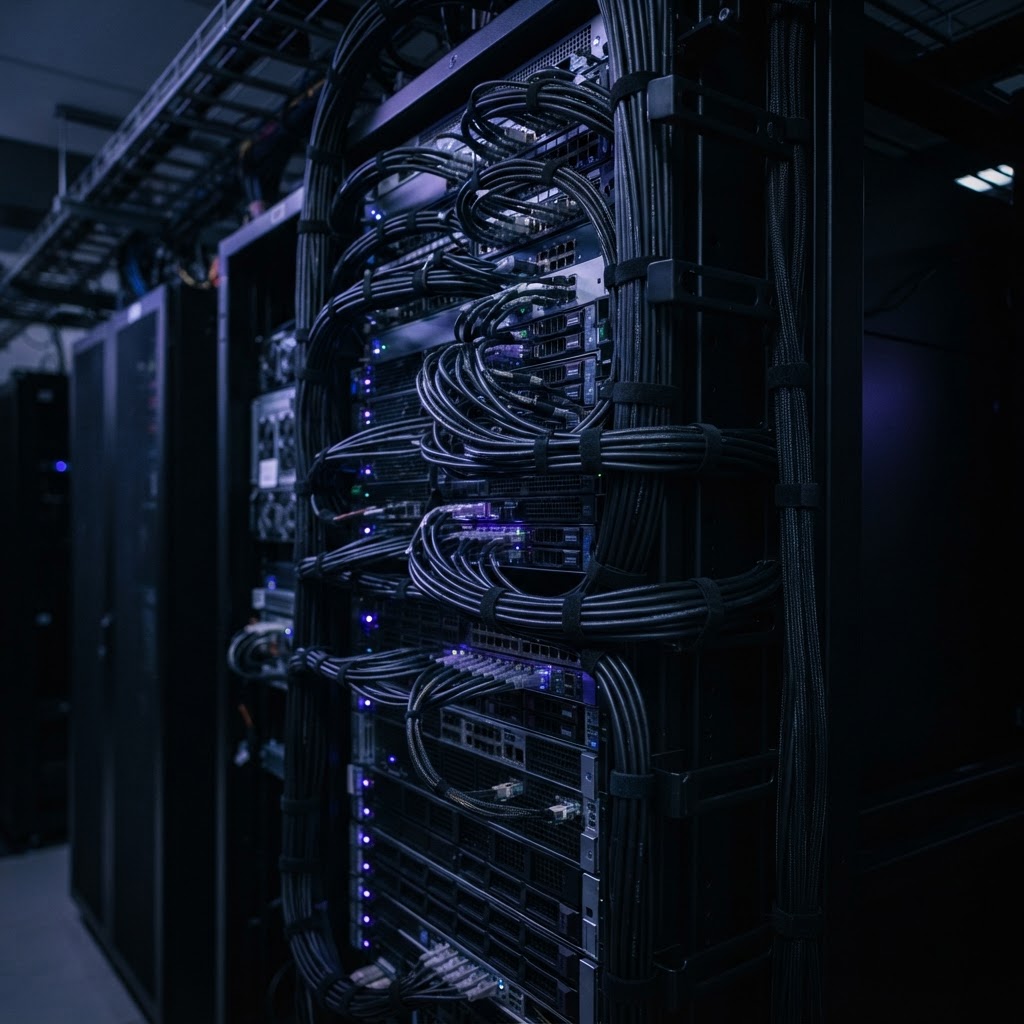
Audit AI infrastructure components across the full workload path
Start with a workload inventory, not an infrastructure diagram. List training, inference, evaluation, experimentation, data preparation, and retrieval workloads, then map the request, dataset, model artifact, and result across the systems involved. This matches the planning guidance that infrastructure should start with the work it must support and the reliability expectations for each workflow. This is the only reliable basis for managing AI compute resources because demand patterns differ sharply between batch training and user-facing inference.
Inspect the six controls that determine scale
Audit each control against measured workload behavior, including normal load, peak load, dependency failure, and recovery. A useful audit records the current constraint, the evidence behind it, the owner, and the change required before capacity expands.
Compute: Separate accelerator saturation from CPU preprocessing pressure.
Storage: Measure read paths, write contention, and artifact access.
Network: Trace traffic between data, compute, and serving layers.
Orchestration: Test placement, retries, quotas, and isolation rules.
Observability: Correlate workload metrics with infrastructure events.
Find the bottleneck before buying more GPUs
GPU utilization alone is not a capacity plan. Compare accelerator activity with queue time, CPU utilization, storage wait time, network retransmissions, and request latency; the component that delays completed work is the constraint. This is where optimizing LLM inference becomes operational rather than theoretical, because token generation can look slow when batching, model loading, or retrieval is actually responsible.
Data pipelines for machine learning deserve the same scrutiny as model code. Profile extraction, transformation, feature generation, indexing, checkpoint writes, and artifact retrieval end to end, since a slow input path turns expensive accelerators into waiting rooms. Use workload-specific tests and verify hardware fit against official GPU specifications, rather than assuming a newer accelerator solves an upstream delay. For broader context, review guidance on scaling open-source AI alongside the infrastructure audit.

Choose an operating model for scalable AI systems architecture
Scaling decisions should follow workload shape and operating constraints, not a default preference for cloud or hardware ownership. Audit the data location, compliance boundaries, burst pattern, procurement lead time, operational staffing, and cost model before selecting a deployment path. The difference between cloud AI infrastructure and on-premise hardware is mostly a matter of flexibility, ownership, and utilization risk.
Compare cloud and on-premise economics honestly
Cloud environments can support training workloads that need intensive GPU or TPU compute and variable capacity, while on-premise systems require initial investment in hardware, facilities, and skilled personnel. Cloud pricing reduces entry costs through pay-as-you-go consumption, but data transfer and usage fees can grow with sustained demand; owned systems shift more responsibility into planning and operations.
The comparison below is useful when the team has stable workloads but uncertain growth, which is the moment when vague assumptions cause expensive commitments.
Decision factor | Cloud deployment | On-premise deployment |
|---|---|---|
Capacity model | Elastic consumption | Owned hardware capacity |
Upfront commitment | Lower entry cost | Hardware and facility investment |
Operating cost exposure | Usage and data-transfer fees | Operations and idle-capacity risk |
Control boundary | Provider-managed environment | Team-managed environment |
Published case result | Not applicable to all workloads | Dropbox reported $75 million saved over two years |
Dropbox reported that outcome after shifting core workloads on-premises while retaining cloud flexibility for non-critical operations, so it is a case result rather than a universal cost forecast. Treat cloud AI infrastructure as a workload-by-workload decision, with hourly, monthly, reserved, committed, or owned-hardware economics documented for each path.
Audit orchestration and serving as production systems
Kubernetes versus serverless is not a religious choice: Kubernetes exposes scheduling, isolation, and lifecycle controls needed for persistent distributed workloads, while serverless designs reduce platform handling for short, event-driven tasks. Evaluate Kubernetes AI workloads by testing GPU placement, quota enforcement, failed-job cleanup, model rollout, and multi-tenant contention; managed Kubernetes platforms are designed to orchestrate an AI and ML lifecycle through a unified control plane.
When assessing network requirements for AI clusters, inspect east-west traffic as carefully as ingress. Distributed training infrastructure engineering breaks down when worker synchronization, shared storage, or checkpoint traffic competes with model serving, so isolate flows and capture latency under concurrent workload pressure.
Turn audit findings into scale gates
An audit is useful only when it changes the release decision. Define a scale gate for every critical workload: a service-level target, a capacity signal, a rollback path, an accountable owner, and a documented exception process. The AI risk management framework is a useful governance reference for incorporating risk management and trustworthiness considerations into AI systems.
Use telemetry that connects cost to user impact
Collect metrics across request traces, queue depth, GPU and CPU activity, memory pressure, storage latency, network behavior, deployment state, and spend allocation. A capacity planning framework should start with the work the platform must support, including training, inference, experimentation, data preparation, and model evaluation.
DevvPro treats this as an engineering discipline: dashboards should answer which model, tenant, data path, or deployment caused a cost or latency change. Build an MLOps infrastructure workflow that links model and data versions to the surrounding infrastructure events; otherwise, incident reviews become guesswork.
Prove readiness with a controlled scale test
Run controlled tests that increase concurrency, dataset volume, worker count, and deployment churn one variable at a time, then verify that alerts, autoscaling behavior, budgets, and rollback procedures react as designed. For RAG pipeline architecture, include retrieval delays and index refreshes in the test because application latency often originates before generation begins.
Use managed Kubernetes simplicity only where the platform boundary matches the team’s operational needs. Scaling open-source AI also requires artifact provenance, dependency controls, and repeatable environment builds, not merely a larger node pool.

Conclusion
Scale only after the audit identifies the true constraint across compute, data, network, orchestration, and operations. Document workload-specific evidence, stress the system under realistic contention, and make cost and reliability signals visible to the people approving growth. Teams can use DevvPro's engineering journal to build a sharper mental model of these architecture decisions. A system is ready to scale when its owners can explain what will fail first, how they will detect it, and how they will recover without improvisation.
Need a clearer way to evaluate your stack? Explore DevvPro’s engineering guides for practical architecture analysis.
Frequently Asked Questions (FAQs)
What components make up modern AI infrastructure?
Modern AI infrastructure includes compute, storage, networking, data pipelines, orchestration, model serving, observability, security controls, and cost governance, because each layer affects whether models can train, deploy, and operate reliably under production demand.
How to design an AI infrastructure for low latency?
Design an AI infrastructure for low latency by tracing the full request path, measuring retrieval, serialization, model loading, network, and generation delays separately, then fixing the slowest dependency instead of optimizing only the model runtime.
What are the best practices for scaling AI infrastructure?
Best practices for scaling AI infrastructure include workload-specific load tests, explicit capacity owners, isolated traffic classes, rollback procedures, and cost attribution, because these controls expose operational limits before additional users or jobs make failures harder to diagnose.
How to manage infrastructure costs for AI startups?
Manage infrastructure costs for AI startups by tagging spend to workloads, tracking idle capacity, selecting a documented consumption model, and reviewing data-transfer exposure, so experimentation remains separate from production commitments and each expense has a technical owner.
Why is data latency the bottleneck in AI infrastructure?
Data latency is the bottleneck in AI infrastructure when compute workers wait for ingestion, transformation, retrieval, checkpoint, or artifact operations, which reduces useful accelerator time even when dashboards show enough nominal GPU capacity.
What are the common hardware pitfalls in AI systems design?
Common hardware pitfalls in AI systems design include choosing accelerators without workload tests, overlooking CPU preprocessing, under-sizing storage throughput, ignoring network contention, and assuming utilization metrics alone reveal whether infrastructure capacity is genuinely productive.