

Introduction
Most developers can rattle off a list of software design patterns, debate the merits of microservices versus monoliths, and implement a clean service layer. But ask them to define a bounded context or explain how aggregates enforce consistency, and the conversation usually stalls. Domain-driven design sits in an odd blind spot: widely referenced, rarely practiced, and almost never taught in a way that sticks. The cost of ignoring it only becomes visible when a codebase scales past the point where intuition alone can hold the architecture together, and by then, the tangled dependencies are already load-bearing walls.
Why Software Architecture Conversations Miss the Point
Architecture discussions tend to fixate on infrastructure. Which cloud provider? Which message broker? Monolith or microservices? These are real decisions, but they skip over a more fundamental question: does the system's structure actually reflect the business it serves? When the answer is no, teams end up fighting their own code to ship features that should be straightforward. Domain-driven design exists precisely to close that gap, giving teams a shared vocabulary and a structural strategy rooted in business reality rather than technical fashion.
The Vocabulary Problem
One of the first casualties in a growing codebase is shared understanding. Engineers use one term, product managers use another, and the database schema uses a third. A "user" in billing is not the same as a "user" in authentication, but the code treats them as one entity with a growing list of conditional behaviors. DDD addresses this head-on with the concept of ubiquitous language: a deliberate, team-wide commitment to using the same terms in code, conversation, and documentation. When language is sloppy, boundaries are sloppy.
Ubiquitous language: A shared vocabulary between developers and domain experts used consistently in code and conversation
Bounded context: A clear boundary within which a particular domain model applies, preventing concept leakage across modules
Aggregate: A cluster of domain objects treated as a single unit for data consistency and transactional integrity
Entity vs value object: Entities carry identity that persists over time, while value objects are defined entirely by their attributes
Context map: A visual and strategic tool that documents the relationships between different bounded contexts in a system
Where Most Teams Go Wrong First
The most common failure mode is not rejecting DDD outright, but applying its tactical patterns without the strategic thinking that gives them purpose. Teams add repository interfaces, create aggregate root classes, and build domain services, then wonder why the architecture still feels arbitrary. Tactical DDD without strategic DDD is just more abstraction with no payoff. The bounded context is the strategic unit that matters most because it determines where one model ends and another begins. Without that clarity, you are just decorating a monolith with fancier class names.
Applying DDD Without the Dogma
DDD has a reputation for being heavyweight, academic, and impractical outside enterprise Java shops. That reputation is largely unearned. The core ideas are applicable to any codebase of sufficient complexity, in any language, at any scale. The key is knowing which parts to adopt and when. Strategic DDD (bounded contexts, context maps, and team alignment) delivers value almost immediately. Tactical DDD (aggregates, value objects, domain events) becomes essential once you need to enforce consistency within those boundaries. You do not need to adopt everything on day one to start seeing returns.
Strategic vs Tactical: Know What You Need
Strategic DDD is about system decomposition. Where do you draw the lines between modules, services, or teams? A bounded context is the answer. Within that boundary, one model reigns. Outside it, a different model with different rules and possibly different terminology applies. This is why DDD and microservices are so frequently discussed together: each microservice ideally maps to a bounded context. But the mapping is not automatic. Splitting a monolith along bounded contexts requires genuine design trade-offs, not just a code-splitting exercise.
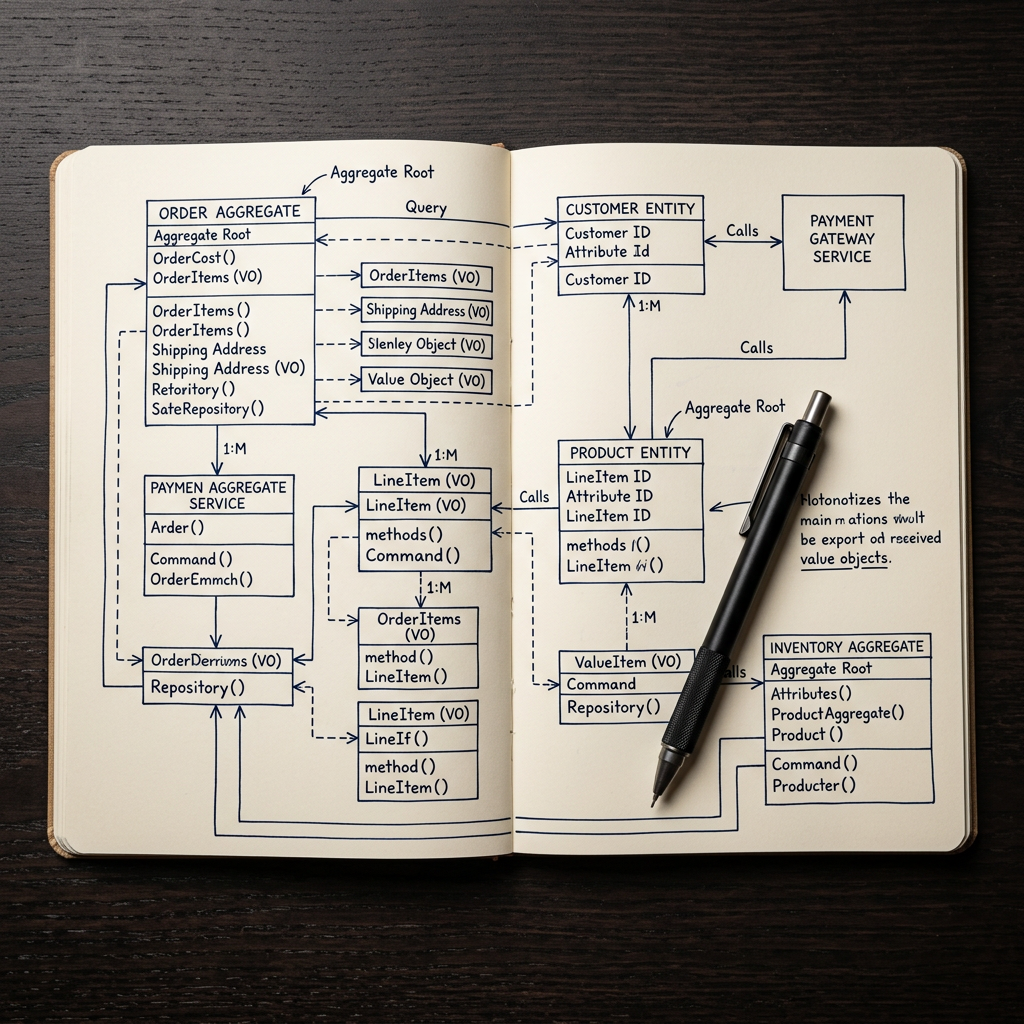
Tactical DDD operates inside a single bounded context. Here, aggregates become the primary tool for maintaining data integrity. An aggregate root controls access to its child entities and enforces invariants. For example, in an order management system, the Order aggregate root ensures that line items, discounts, and totals remain consistent within a single transaction boundary. Microsoft's guide to tactical DDD provides a useful reference for implementing these patterns in distributed systems. Getting aggregate boundaries wrong leads to either overly large transaction scopes or scattered consistency logic that is nearly impossible to reason about.
When DDD Earns Its Keep (and When It Does Not)
DDD shines in domains with complex, evolving business rules: insurance, logistics, financial services, healthcare, and multi-tenant SaaS platforms. These systems have nuanced behavior that cannot be captured in CRUD operations and basic validation. If the domain logic is genuinely simple, applying full DDD is over-engineering. A straightforward content management system or a basic REST API wrapper around a database does not need aggregates or bounded contexts. The decision framework is straightforward: if two domain experts disagree about the meaning of a term in different parts of your system, you likely need bounded contexts.
One practical test is to examine your data model. If a single entity class has grown to 30+ fields with conditional behavior depending on which part of the system is accessing it, that entity is serving multiple contexts and should be split. Paying down technical debt in these situations almost always involves discovering implicit bounded contexts that were never made explicit.
Building the Muscle: From Theory to Practice
Understanding DDD concepts intellectually is the easy part. The harder part is developing the instinct to apply them during the messy reality of sprint planning, legacy codebases, and cross-team negotiations. This is a skill that compounds over time, and there is no shortcut for it. But there are concrete starting points that accelerate the learning curve significantly.
Event Storming and Collaborative Modeling
Event storming is the most practical on-ramp to DDD for teams that have never used it. The exercise involves gathering developers, product managers, and domain experts in a room (or a virtual whiteboard) and mapping out business events in temporal order. What happens first? What triggers what? Where do handoffs occur? The output is a rough context map that reveals natural boundaries in the domain. This is more productive than any architecture diagram drawn in isolation, because it forces the people who understand the business to articulate their mental models explicitly.
Teams that run event storming sessions often discover that their current service boundaries do not match the actual domain boundaries. A payment service handles refund logic that belongs in the orders context. A user service manages preferences that belong in the notification context. These revelations are uncomfortable but invaluable. At DevvPro, coverage of modular architecture and scalable architecture patterns frequently returns to this same root cause: misaligned boundaries generate complexity that no amount of refactoring at the code level can resolve.
Architecture Decision Records and Iterative Adoption
Adopting DDD does not require a rewrite. Start by documenting architecture decisions using architecture decision records (ADRs). When you identify a bounded context, write it down. When you define an aggregate boundary, record the reasoning. Over time, these records create a living map of your domain model that new team members can reference and existing team members can challenge.
The iterative approach works especially well in legacy systems. Pick the most painful part of the codebase, the module where every change causes unexpected side effects, and model it as a bounded context with explicit boundaries. Extract it gradually, using anti-corruption layers to prevent the old and new models from contaminating each other. This is the same principle behind safe refactoring: small, reversible changes that improve structure without risking the whole system.
Event-driven architecture fits naturally here. Domain events published from one bounded context allow other contexts to react without direct coupling. An order placed in the sales context triggers fulfillment in the logistics context without either context knowing the other's internal model. This is where DDD and SOLID principles reinforce each other. The dependency inversion principle maps directly to the idea that contexts should depend on abstractions (events, contracts) rather than concrete implementations from other contexts.
The Bigger Picture for Your Career
Domain-driven design is not just an architecture technique. It is a communication framework, a team alignment tool, and a way of thinking about software that treats the business domain as the primary organizing principle. The developers who invest in understanding it gain something that no framework or language can provide: the ability to decompose complexity into manageable, coherent pieces that multiple teams can work on independently.
For mid-level engineers looking to make the jump to senior or staff roles, DDD fluency is a differentiator. Architecture reviews, system design interviews, and cross-team technical decisions all require the ability to think in bounded contexts and communicate trade-offs clearly. DevvPro's engineering journal consistently emphasizes that the gap between competent and exceptional is not about writing more code, but about making better structural decisions. DDD is one of the most effective lenses for developing that judgment.
Conclusion
Domain-driven design remains one of the highest-leverage software architecture skills that most developers never formally learn. The strategic concepts, bounded contexts, ubiquitous language, and context mapping are immediately applicable to any team struggling with a codebase that has outgrown its original structure. The tactical patterns give you precise tools for enforcing consistency where it matters. Whether you start with an event storming session or simply document the implicit boundaries in your current system, every step toward domain awareness makes the architecture more resilient and the team more aligned.
Explore more on scalable architecture, software design patterns, and engineering best practices at DevvPro.
Frequently Asked Questions (FAQs)
What is domain-driven design?
Domain-driven design is a software development approach that structures code and architecture around the core business domain, using shared language and explicit model boundaries to manage complexity.
How to implement bounded contexts in software architecture?
Identify distinct areas of your business where terms, rules, or models differ, then enforce clear boundaries between them in code through separate modules, services, or anti-corruption layers.
What are aggregates in domain-driven design?
Aggregates are clusters of related domain objects grouped under a root entity that controls access and enforces consistency rules within a single transactional boundary.
Is domain-driven design worth learning for mid-level developers?
Yes, because understanding bounded contexts and domain modeling is one of the clearest differentiators between developers who write features and those who can architect systems that scale.
When should you avoid domain-driven design?
Avoid full DDD adoption when the business logic is genuinely simple, such as basic CRUD applications or thin API wrappers, where the overhead of formal domain modeling outweighs the benefits.